Philosophy
My first experience with the violin was when I was about 9 years old. My family and I went to visit relatives, someone had taken out a violin and was playing it. I remember walking into the room, a huge amount of sound was radiating like sunlight from the instrument and I was instantly captivated by the mystery of "how does it do that??" The feeling of mystery has never left. It has changed, become more subtle and sophisticated (I hope) but remains essentially the same.
As I learned more about the history of the violin the sense of awe and wonder only grew. The individual most often credited with the invention of the violin is Niccolo Amati in the 16th Century. The violin has remained essentially unchanged since it's invention. A violinist from the 16th Century would recognize and be able to play a 20th century violin. I can't think of any other comparable technology that has survived so completely and intact for 400 years! 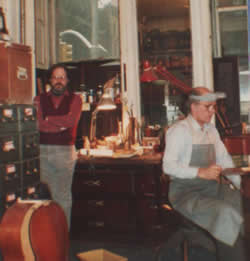
The next phase of my education about the violin came when I started to work for Steve McGhee in NYC. I loved working there. The workshop felt comfortable, a chaotic mix of tools and instruments. Steve had worked at the Francais shop (the most prestigious shop in NY at the time) for many years and he taught me the techniques and methods used there. Steve was also one of the funniest and brightest individuals I've ever met. There were three of us in the shop, Steve, myself and Kerry Keane who is now the appraiser for Christie's Auction house in London.
I would typically arrive at the shop before anyone else. Normally I would take care of a few chores and then I would pick up one of the instruments in the shop, perhaps a Gofriller, Guadanini, Amati etc and play it for twenty minutes or so. I'd try it with a modern bow by Charles Espey or a Sartory bow or a Nuremburger bow. It was during this morning ritual that I developed a more refined, sophisticated sensibility with an abiding respect and appreciation for these amazing instruments. The shop was also used as a rehearsal room since Steve was also a working professional cellist. That experience broadened my understanding for how musicians work and develop. Another aspect to my ongoing education has been my membership and active participation in a private internet group of violinmakers. These discussions have broadened my perspective on modern acoustics, revealed different, interesting and often surprising ways that other makers have solved various technical problems. It's been very satisfying being part of a worldwide community of violinmakers. 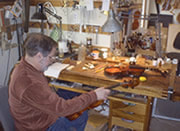
Now that I've been making and repairing instruments in the violin family for about 25 years, my respect and awe remain intact but I've also tried to separate myth, and fantasy from fact. My greatest current interest is the development of a plausible recreation of the varnishes used by the great Old Master violinmakers in Italy. I've shared some of my own work with my colleagues by publishing several varnish recipes.
My efforts to try to recreate the fabled Cremonese varnish has been in a very intensive state for the last nine or ten years. I have an extensive private library of books on artist's materials and techniques with translations of ancient manuscripts as well as modern works. A large metal locker filled to capacity with various varnish and coloring ingredients gathered and collected over many years testifies to my quest for this magical varnish. We may never know exactly how the Cremonese made their varnish but I believe that I've come very close. However there's a great deal more to coating a violin than the varnish itself. There are still many important unresolved questions in my mind about what the Cremonese used as a size or ground coat on their instruments. I've studied the scientific literature that's been done on Old Master varnishes written by Raymond White, Fry, Bill Fulton, Barlow/Woodhouse, Michelman and Lois Condax. A recipe published in the Guild of American Luthiers by Keith Hill, Instrument Maker titled 'Ash Varnish' was very helpful to me in developing my own recipe. I'm grateful to it's author for sharing it. I've also received much guidance, encouragement and inspiration from my friend and colleague Michael Darnton, a fabulous violinmaker in Chicago. I make all the colors for my instruments from raw ingredients, principally from a root called madder (rubia tinctorum). I even have madder plants growing on my property here in Virginia. Most recently I've become interested in learning more about the technical side of acoustics. My approach to violinmaking has been a mix of alchemy and science, tradition and experiment. I always try to remember that the finest violinmakers of all time relied on their intuition, tradition and talents to create great masterpieces without benefit of computers or modern technology. Violinmaking is a very traditional craft/art but I've tried to introduce some elements into my instruments that I think are improvements. A colleague once said to me " I like that you work within the Italian tradition but aren't afraid to try different things". I took that as a great compliment because that's exactly what I strive for. 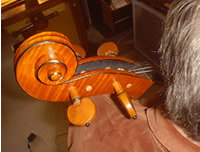
Probably the most radical thing I do is reverse the order of the pegs on my cello. I got this idea from Tom Sparks who teaches violinmaking and repair at University of Indiana at Bloomington. The arrangement of the pegs on a violin are placed so that there is room for the left hand. The E/A are high and the G/D are placed lower on the pegbox. But on the cello the C peg often gets in the way of the player. There have been various attempts to fix this problem such as the 'posture peg' a peghead that you can remove after you've tuned the instrument. By simply reversing the order of the pegs with the C/G placed higher than the A/D the player has far more room. Another advantage to this arrangement is that the bottom strings are longer, an acoustical benefit, and have a less extreme angle into the pegbox. Most players and dealers have thought this change to be an improvement.
|